Returning to cycling after 50 is best treated as a fresh starting point, not a test of whether you can still ride the distances or speeds you managed before the break. Fitness, comfort and confidence may have changed, and your old training numbers may no longer reflect what is manageable now.
If the break was simply due to work, weather or other life commitments, a gradual return may be enough. If it followed an injury, surgery, significant illness or troubling symptoms during exercise, get appropriate medical or rehabilitation advice before using a general comeback plan. For everyone else, the practical approach is to check your health and equipment, start with short easy rides, then build repeatable riding before adding harder efforts.
There is limited research defining an ideal return-to-cycling schedule specifically for adults over 50. The guidance below applies general exercise principles cautiously: age alone does not decide readiness, and there is no universal first-ride duration or weekly progression rate that suits every rider.
Decide whether this is a simple break or a recovery
A period away from the bike can mean very different things. If you were generally healthy and inactive because of a busy year, the main challenge may be rebuilding endurance and cycling-specific comfort. A break caused by an active injury, an operation, a cardiac event or a significant illness needs a different decision. In those cases, a clinician or physiotherapist who understands your circumstances can advise when and how to resume.
Do not use age as the only test for whether you need a medical check. Consider your current activity, known health conditions, symptoms and the kind of riding you plan to do. If you have symptoms that may be related to cardiovascular, metabolic or kidney disease, or you have unexplained symptoms with exertion, seek medical advice before exercising. A clinician can also help if you have a relevant diagnosis and are unsure whether your intended effort is appropriate. General exercise-screening guidance is not a personal clearance decision.
Chest pain or pressure, fainting or near-fainting, severe or unusual breathlessness, or neurological symptoms during exercise are reasons to stop and seek urgent assessment. For acute or severe symptoms, follow local emergency guidance. Concerning palpitations also warrant medical advice, particularly if they occur with dizziness, chest symptoms or breathlessness. Do not try to test whether these symptoms will pass by riding on.
For a straightforward return after inactivity, a check-up is not automatically required just because you are over 50. But if you are unsure about a health condition, have new or unexplained symptoms, or intend to jump straight into hard training, discuss the plan with a qualified health professional first.
General adult guidance recommends at least 150 minutes of moderate-intensity aerobic activity each week. Think of that as a longer-term public-health direction, not a first-week target or a requirement to be met entirely on the bike. A few short rides may be a sensible start, especially if cycling is currently your main exercise.
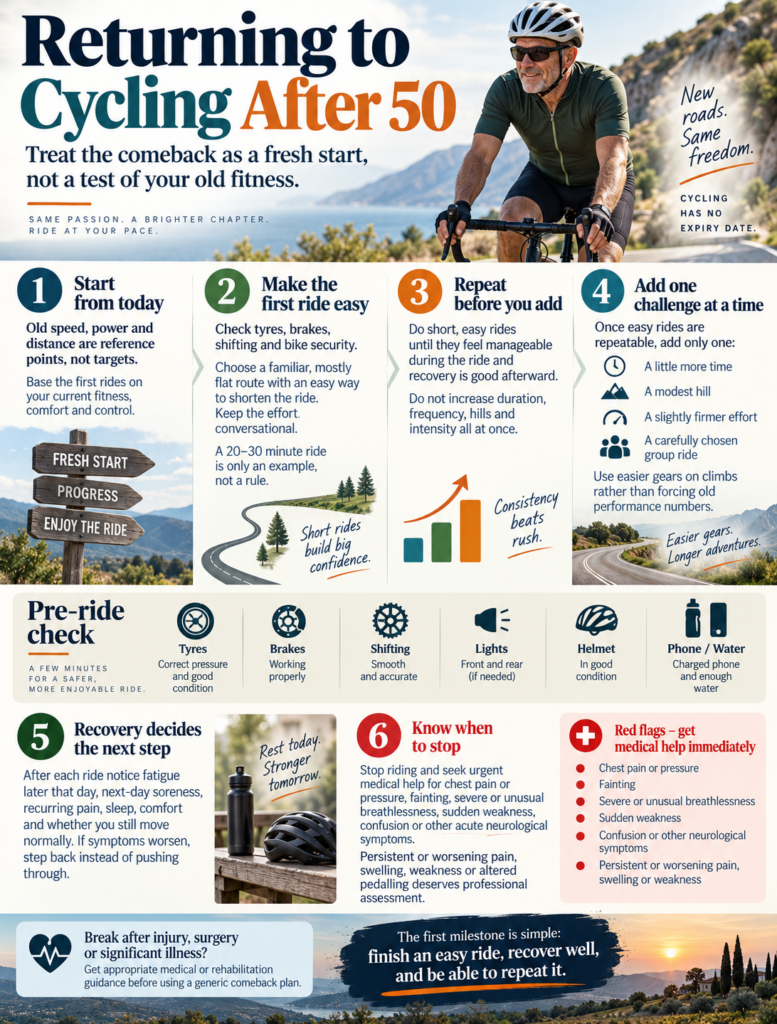
Make the first ride easy to start and easy to end
Before heading out, check that the bike is safe and functional. Look over the tyres and wheels, test both brakes, and check that the drivetrain shifts and runs as expected. Make sure lights and other visibility equipment work if you may ride in low light, and use a helmet appropriate to local guidance. If the bike has been stored for a long time or anything feels loose, damaged or unreliable, have it inspected before riding.
Check comfort without assuming that every ache is a bike-fit problem. Make sure you can reach the brakes securely, steer and change gears without strain, and sit in a position you can maintain. If you have changed bikes, have a previous injury, or feel persistent discomfort in the saddle, hands, neck, back or knees, a qualified bike-fit professional may help assess the setup. A fit adjustment is not a substitute for clinical assessment when pain is persistent or worsening.
If handling feels rusty, practise starting, stopping, braking, turning and shifting in a quiet, low-traffic place before mixing with cars or riding a busy path. Choose a familiar, mostly flat route with a straightforward way to shorten the ride or get home. Daylight and lighter traffic can reduce the number of demands you are managing while you rebuild confidence. Check the local rules and conditions for where you ride.
Use time and effort, not old distance or speed, to choose the first outing. A ride of 20 to 30 minutes is one possible example, not a prescription. If that sounds too long for your current activity level, start shorter; if you have recently been active in another way and feel well, you may be comfortable with more. The route should make it easy to turn back before fatigue affects your control.
Keep the effort conversational: you should be able to speak in sentences rather than pushing to hold an old pace or power target. Perceived effort is a useful way to manage an easy ride, but it is not a medical safety test. Start gently and let the first part of the ride serve as an easy transition, rather than treating a warm-up or stretching routine as a guarantee against injury.
Build repeatable riding before adding workload
For a basic cycling comeback plan, begin with short, easy rides that leave you feeling you could have continued. Repeat a similar ride until it feels manageable during the ride and recovery is satisfactory afterwards. Then make one main change, such as adding a little time to a ride or fitting in another easy outing. Avoid increasing duration, frequency, hills and intensity all at once.
There is no well-established rule that every rider should increase training by a fixed percentage each week. A commonly repeated 10% rule is a coaching heuristic, not a universal safety threshold. A small increase may still be too much after illness, poor sleep or a long inactive period; a larger increase may be manageable for someone already active and recovering well. Let the response to the actual workload guide the next step.
Pay attention to more than how the ride felt in the moment. Consider whether you are unusually tired later that day, whether pain is worse the next day, and whether you can pedal smoothly without changing your movement to avoid discomfort. If fatigue is excessive or symptoms are increasing, repeat an easier ride, reduce the workload or take more recovery time. If pain persists, worsens, causes swelling or weakness, or changes how you move, pause progression and seek an appropriate assessment.
Mild, temporary muscle tiredness can happen when you return to an activity, but it should not be used to explain away persistent or localized pain. Saddle discomfort can also appear when you resume riding, but repeatedly riding through worsening discomfort is not a useful adaptation strategy. Review the time in the saddle, riding position and contact points; if symptoms continue, consider a clinician or bike-fit professional depending on the type of problem.
Rest days do not need to follow a rigid calendar. The useful question is whether you are ready to repeat the previous workload without carrying significant fatigue or worsening symptoms into the next ride. Someone who was formerly a regular cyclist may find easy rides return quickly, but that history does not restore current conditioning automatically. A recreational rider may prefer several shorter outings rather than one long weekend ride. Both approaches can work if the load remains manageable.
Add hills, group rides and speed one step at a time
Once easy rides are repeatable and you are recovering well, introduce more demanding riding selectively. You might add a modest hill to a familiar route, extend one outing, or include a short period of firmer but controlled effort. Keep the rest of the ride easy while you judge the response. If the new challenge leaves you disproportionately fatigued or uncomfortable, return to the previous level rather than pressing on because a plan says you should be progressing.
Old heart-rate zones, power targets and average speeds can be misleading after time away. Your equipment may also have changed, and conditions such as wind, temperature and terrain make speed a poor measure of effort. Early on, conversational effort and perceived exertion offer a straightforward guide to keeping rides controlled. If you use a power meter or heart-rate monitor, treat old numbers as historical reference points, not targets you must immediately reclaim.
There is no universal cadence minimum that a returning rider must meet. Choose a gear and pedalling rhythm that feel smooth and comfortable rather than forcing a number. If a climb makes you grind heavily, use an easier gear where available, reduce the pace, or choose a flatter route while strength and endurance rebuild.
Group riding adds traffic awareness, close spacing and the pressure to match someone else’s pace. Before joining a fast or unfamiliar group, ride with one or two considerate companions, or choose a no-drop ride whose pace and route you can check in advance. Be clear that you are rebuilding and need the option to turn back. If you are concentrating hard just to hold the wheel, the group may be too quick for this stage of your return.
Bring back long rides and previous performance goals only after the shorter, easier workload is stable. Increase the duration of one ride while keeping other rides easy, rather than pairing a new distance record with hard intervals or a demanding climb. If your aim is an event, set the goal around arriving prepared and able to complete it comfortably; there is no reliable timetable for regaining a particular former level of fitness.
Use symptoms and recovery to decide whether to progress
After a ride, note the duration, how hard it felt, any discomfort, and how you feel later and the following day. You do not need a complex training log. A few notes can reveal that a particular route, duration or riding position repeatedly causes trouble, or that a ride which seemed easy at the time leaves you unusually tired.
For pain that returns in the same place, worsens from ride to ride, persists despite reducing the workload, or comes with swelling, weakness or altered pedalling, pause the progression and seek professional advice. A physiotherapist or clinician can assess symptoms, especially when the break followed an injury or the cause is unclear. A bike-fit assessment can be useful when the concern appears linked to position or contact points, but it cannot rule out a medical cause.
If you are returning after an injury, surgery or significant illness, do not borrow a generic progression schedule. The appropriate starting point depends on what happened, your recovery and any restrictions from your care team. Resume only when you have relevant guidance, then rebuild gradually and seek reassessment if symptoms return or movement changes.
The most useful first milestone is not a distance, speed or training zone. It is being able to complete an easy ride, recover appropriately and repeat it without concerning symptoms. Once that is reliable, add one challenge at a time and keep the option to step back if your health, comfort or control says the workload is too much.