A saddle that is too high can make you reach for the pedals; one that is too low can leave your legs feeling cramped. Those are useful clues, but knee pain alone cannot tell you which way to move the saddle. Similar symptoms can come from cleats, saddle position, crank length, riding load or causes unrelated to bike fit.
The safest way to check saddle height is to look for a pattern, then make a small, reversible change and test it under familiar conditions. There is no single knee angle or inseam formula that works for every rider, and the available evidence does not establish a different ideal saddle height based on age alone.
Look for a pattern, not one symptom
Saddle height affects how much your knee and hip bend through each pedal stroke. If the saddle is too low for your setup, your leg stays more flexed. If it is too high, you may have to reach to maintain contact with the pedal. In either case, your body can compensate, which makes the underlying fit issue harder to identify.
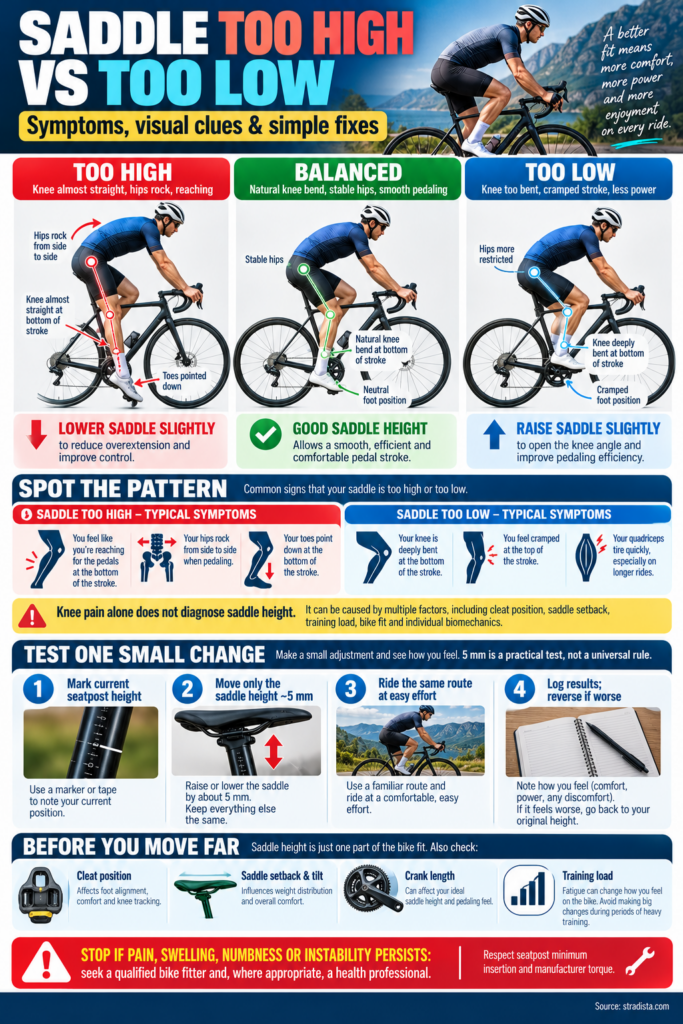
For a possible high saddle, look for signs at the bottom of the stroke: reaching for the pedal, pointing the toes to maintain contact, or rocking the pelvis from side to side. You may also notice discomfort around the back of the knee or hamstring, or find that pressure shifts toward the front of the saddle. These are clues, not proof. Flexibility, cleat position, saddle setback and crank length can affect the same sensations.
A possible low saddle may feel cramped, with a deep bend in the knee at the top of the stroke. Some riders notice early quadriceps fatigue or discomfort at the front of the knee. Lower positions increase knee flexion, and research indicates they can increase muscle and joint loading, especially when power demands are higher. That does not mean that every low-feeling position is wrong or that raising the saddle will necessarily resolve pain.
Consider when the problem appears. A discomfort that emerges after an hour may reflect a fit issue, but it may also follow a longer ride, harder effort or recent increase in training. Symptoms that appear mainly on steep climbs or when pushing a heavy gear may relate partly to the extra force required, rather than saddle height alone.
Signs the saddle may be too high
At the bottom of the pedal stroke, a high saddle can leave you feeling as if you have to stretch to reach the pedal. Watch for your hips shifting from side to side, one or both toes pointing down more than usual, or a leg that appears to straighten excessively. On the bike, the sensation may be an unstable pedal stroke rather than an obvious stretch.
A rider may use toe-pointing to make a high saddle reachable. That compensation can hide the problem during a quick visual check, so do not judge the position by leg extension alone. Look at the whole movement: does the pelvis stay relatively steady, and can you pedal smoothly without reaching at the bottom of the stroke?
Discomfort behind the knee or along the hamstring can accompany over-reaching, but pain location is not a dependable measurement. If those symptoms occur alongside pelvic rocking or a reaching sensation, lowering the saddle a little is a reasonable test. If the saddle is lowered and the discomfort worsens, or you begin to feel cramped, return to the recorded position and reconsider other variables.
Signs the saddle may be too low
A low saddle can make the top of the pedal stroke feel crowded and keep the knee more bent through the rotation. You may notice your thighs working hard at a familiar pace, early quadriceps fatigue, or a tendency for your knees to move or flare outward. Some riders report discomfort at the front of the knee.
Front-of-knee pain is not a diagnosis of a low saddle. It can have several contributing factors, including cleat position, saddle fore-aft position, cadence, gearing and a sudden change in riding volume. If pain began after a period of harder or more frequent riding, consider that change as well as the bike setup.
When a cramped pedal stroke and other signs point toward a low saddle, try raising it slightly. A higher position may reduce excessive knee bend, but raising the saddle too far can create a new reaching problem. The aim is not to make the leg look as straight as possible; it is to find a position that allows stable, comfortable pedalling with your normal shoes and pedals.
Make a small change you can evaluate
Before adjusting anything, record the current position. Mark the seatpost at the frame, note the saddle’s fore-aft position, and take a photograph from the side if that helps you reproduce the setup. If you measure saddle height, use the same point on the saddle each time and keep its tilt consistent. Curved saddles and changes in tilt can make measurements from different reference points misleading.
Check the bike while wearing your usual cycling shoes and using your usual pedals. Cleat position, footwear and pedal height all affect how your leg reaches the bottom of the stroke. Observe both sides if possible, but do not force your heel down or point your toes to meet a particular visual target. A static check can be a starting point; how you pedal dynamically matters more than matching one universal angle.
If the signs point clearly toward high or low, change only the saddle height and move it a few millimetres at a time. Around 5 mm is a commonly used practical test, not a scientifically established dose or a universal rule. Small adjustments make it easier to tell whether the change helped and reduce the chance of trading one problem for another. Make sure the saddle remains within the seatpost’s insertion limits and secure the clamp according to the manufacturer’s instructions.
Test the change on familiar terrain and at a manageable effort. Pay attention to whether the original symptom appears, whether your pelvis remains steady, and whether the stroke feels less cramped or less stretched. Give yourself more than a few pedal strokes to assess it, but do not push through escalating pain just to complete a test. Record what changed and reverse the adjustment if it makes you less stable, causes new pain or brings on numbness.
When the result is unclear, return to the recorded setup rather than making another adjustment immediately. If you change height and saddle setback at the same time, for example, you will not know which change affected the result. One variable at a time is a useful principle, although a position change can have knock-on effects elsewhere in your fit.
Check the rest of the fit before moving far
Saddle height is only one part of your position. Saddle setback affects where your knee sits in relation to the pedal and can change how the leg feels through the stroke. Saddle tilt may affect pressure and how you support yourself. Cleat placement, crank length and pedal height also alter the effective reach to the pedal. If your symptoms do not fit the usual high-or-low pattern, avoid making a large height adjustment before checking these factors.
Handlebar reach and drop can influence how you hold your trunk and pelvis. A position that feels manageable on a short ride may become uncomfortable on a longer one, particularly if you are reaching forward or supporting yourself differently as you tire. That does not automatically mean the saddle is wrong, but the saddle and handlebar positions need to work together.
Riding conditions matter too. A recent increase in distance, repeated hard efforts, high-torque climbing or a change in cadence can affect how your legs feel. If discomfort started after a training change, ease back to a manageable workload while you assess the bike. Repeatedly adjusting saddle height in response to every sore ride can make it harder to identify the real cause.
There is no need to chase a single knee-angle number or inseam-based measurement as the final answer. Such figures can offer a starting reference, but different methods use different landmarks, and riders vary in anatomy, crank length, cleat setup and pedalling style. A qualified fitter can observe your movement while riding and help assess several interacting variables when a home check does not provide a clear answer.
Know when to stop experimenting
Ordinary discomfort after an unfamiliar position is different from pain that is persistent, worsening or severe. Stop treating the problem as a saddle-height puzzle if you have swelling, a knee that locks or gives way, marked instability, weakness, numbness or other neurological symptoms, or difficulty walking normally. Symptoms after an injury also merit appropriate assessment. A bike adjustment cannot diagnose the cause of these problems.
If pain continues despite small, sensible changes, or keeps returning as soon as you resume normal riding, seek help rather than making repeated adjustments. A bike fitter can assess position and pedalling; a sports-medicine or other appropriate health professional can evaluate symptoms that may not be caused by the bike. A history of injury, noticeable asymmetry or uncertainty about what you are seeing can also make professional assessment more useful than further trial and error. For a clear, mild fit concern, start by identifying whether you are reaching or feeling cramped, record the current setup, and test one small change. If the clues conflict or the symptoms persist, look beyond saddle height before changing it again.