Choosing the right bicycle saddle width starts with your sit-bone measurement, but that measurement does not produce one universally correct number. It helps you build a shortlist. Your riding posture, the saddle’s shape and the way it is set up all affect whether it supports your sit bones without creating excessive pressure elsewhere.
That distinction matters if a saddle feels uncomfortable despite matching a sizing chart. The problem may be its width, but it could also be its curvature, position, your reach to the bars or another part of the fit. Treat width as a useful first filter, then judge the saddle on the bike and on rides long enough to reveal how it feels under sustained pressure.
Sit-bone width is a starting point, not a saddle-size formula
Your sit bones, or ischial tuberosities, are the bony points at the base of the pelvis that can support you on a saddle. Sit-bone width is the distance between those points. Saddle width is the saddle’s overall width, usually given at its broadest point. The two measurements are related, but they are not interchangeable: the saddle needs to offer useful support under your sit bones, and its shape affects where that support lies.
A saddle that is too narrow for your contact points may leave the sit bones inadequately supported. A saddle that is too wide can interfere with leg movement or create rubbing, particularly when you ride in a forward, low position. Neither outcome can be predicted from width alone. Curvature, padding, the transition from the rear to the nose, and where you sit on the saddle all matter.
Posture changes that contact position. In a more upright touring, hybrid or city position, the pelvis is generally less rotated forward than it is on an aggressive road bike. As you lean forward, the pelvis rotates and the saddle contacts a different area. That is why a measurement taken in a very upright posture may not be the best guide for a bike you ride with a pronounced forward lean.
There is no single cross-brand rule that converts sit-bone width into saddle width. Manufacturers may use different measuring methods, posture categories and allowances, designed around their own saddle shapes. Measure first, then follow the sizing guidance for the brand and type of saddle you are considering rather than combining numbers from several charts.
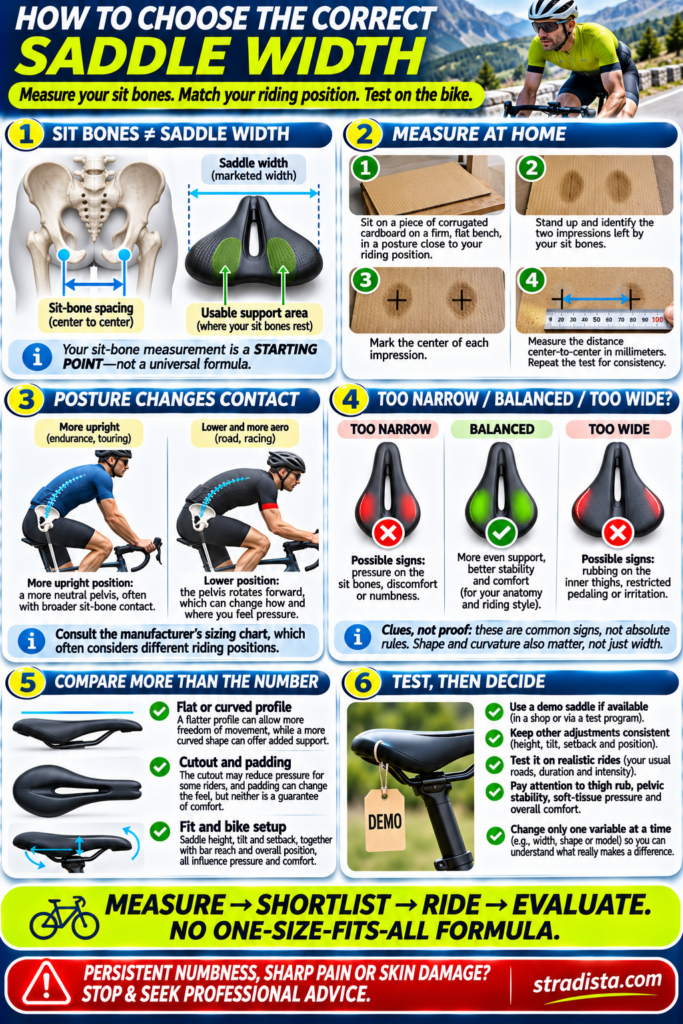
Measure in a posture close to your actual riding position
A home impression can help narrow your options. Use firm corrugated cardboard or a similar material that records two clear sit-bone indentations. Sit on it on a firm, level surface and allow your weight to make an impression. The aim is to identify the centres of the two marks, then measure the distance between them.
Repeat the measurement if the impressions are faint or difficult to interpret. If you have more than one bike, consider how you sit on each: a relaxed position on a touring bike may differ substantially from your position on a road bike. Try to reproduce the approximate hip angle of the bike you are fitting, rather than measuring only while sitting bolt upright. If you cannot get a clear, repeatable result, a bike shop or fitter may be able to measure it more consistently.
This process gives you an estimate, not a precise diagnosis of how your body will interact with every saddle. A home measurement can be affected by the material, the way you sit and how clearly you can identify the marks. If the number seems uncertain, avoid treating a few millimetres of apparent difference as decisive.
When comparing saddles, check the actual width and the manufacturer’s instructions. Published width is not necessarily the same as usable support width: a saddle may flare at the edges, curve away from the area where you sit, or have a shape that changes how much of its platform supports you. Two saddles with similar nominal widths can feel quite different.
Use the measurement to shortlist saddles for your riding position
Enter your measurement into the sizing chart for the specific saddle brand, paying attention to any distinction between upright and forward riding positions. Use its recommendation to identify a sensible starting range, not to decide that one size must fit. A city saddle and a road saddle with the same stated width may have different shapes and intended contact areas.
If you ride both an upright bike and a road bike, do not assume that the same width will suit both simply because your sit-bone measurement is unchanged. The posture and saddle design differ. Check the recommendations for each bike and compare the saddles in the position in which you will actually ride them.
Research supports the idea that saddle width relative to the sit bones can affect pressure distribution, but it does not establish one allowance for every rider. A study involving female cyclists reported improved pressure distribution and comfort when the saddle exceeded ischial width by about 1 cm in the conditions tested. That result is useful evidence, not a universal prescription for men and women, older riders, every discipline or every saddle shape.
Age, height, weight, sex and bike frame size do not replace a sit-bone measurement or a real-world trial. There is no evidence here for a special saddle-width rule for cyclists aged 50 and over. If you have a history of hip, pelvic or back problems, reduced tolerance for pressure, or skin sensitivity, those are good reasons to test carefully and seek professional help if discomfort persists, not reasons to automatically choose a wider saddle.
Compare shape and setup, not just the width printed on the box
Once you have a shortlist, consider the saddle’s shape as well as its width. Some saddles have a relatively flat platform; others are more curved or have a different transition towards the nose. A cutout or central channel changes the way the saddle supports the body, but its presence does not guarantee relief from numbness or pressure. Padding and gel are also design choices, not automatic measures of comfort.
Think about how the saddle works with your pedalling. If the rear edges or sides seem to catch your thighs, width or shape may be involved. If you feel concentrated pressure towards the front, that does not by itself prove the saddle is too narrow: position, tilt, reach and the saddle’s profile may also contribute. These clues can help guide a test, but they do not identify the cause on their own.
Setup can make a plausible saddle feel wrong. A change in saddle height, tilt or fore-and-aft position can alter pressure and how steadily you sit, while handlebar reach may affect how much weight you place through the saddle. If you change the saddle and several fit settings at once, it becomes difficult to tell which change helped or made things worse.
Start with a reasonable setup and change one variable at a time. Keep the bike, riding position and other equipment as consistent as practical while you assess the saddle. Note when discomfort begins and where you feel it. A problem that appears only on longer rides may not show up during a quick shop test or a short trainer session.
Test the saddle on rides that resemble your normal riding
If possible, use a retailer, fitter or manufacturer test-saddle or exchange programme. Policies and availability vary, so check the terms before buying; do not assume a used saddle can be returned. A controlled trial is especially useful when you are choosing between two plausible widths or have already tried several saddles.
Test on the bike and in the posture for which the saddle is intended. Build up to rides that reflect your usual duration rather than rejecting a saddle solely on a brief indoor spin. The aim is to assess support and pressure over time, including whether you can pedal freely and stay stable without rubbing. Record what you notice so you can compare changes rather than relying on a vague impression after each ride.
Some initial awareness of a new contact point does not necessarily mean the width is wrong. But do not assume that every discomfort will disappear as you get used to the saddle. Sharp or increasing pain, persistent numbness, genital pain, skin damage or symptoms that continue after riding are reasons to stop treating the issue as a simple sizing puzzle.
When testing, change one thing at a time. If you swap the saddle, alter its height and tilt, move the handlebars and change shorts together, you will not know which adjustment affected the result. Keeping the rest of the setup steady makes the trial more informative.
If the saddle still hurts, troubleshoot before buying another width
Return to the basic questions: Does the saddle follow the relevant brand’s sizing guidance? Does its shape suit your riding posture? Is it positioned consistently, and can you reach the bars without feeling pushed forward or heavily loaded on the saddle? Could clothing, ride duration or a recent increase in riding be affecting the discomfort? These are possibilities to investigate, not proof that any one factor is responsible.
Do not respond to every pressure problem by moving to a wider saddle. A wider model may improve support in one situation but cause thigh interference or discomfort in another. Likewise, going narrower can create more clearance but may leave the sit bones less supported. Your measurement helps limit the options; the fit on your bike determines whether an option is workable.
If symptoms persist despite sensible setup changes, a qualified bike fitter can assess the saddle alongside posture and contact points. Seek advice from a healthcare professional for persistent or worsening pain, numbness, skin injury, bleeding, or discomfort that remains when you are off the bike. Saddle choice is not a diagnosis, and repeatedly buying different widths can delay attention to another cause.
The practical sequence is straightforward: measure your sit bones in a posture that resembles your riding, use the selected brand’s chart to choose a starting range, then test the saddle on your bike over realistic rides. Keep the measurement in perspective. Comfort depends on width, shape, posture and setup working together, not on finding a single number that guarantees a pain-free ride.