A past personal best can be a poor guide to what you should train for now. So can a target copied from a younger riding partner. The useful question is not what someone your age ought to manage, but what would be challenging and worthwhile given your current riding, health, recovery, schedule and the demands of the route.
Realistic cycling goals after 50 can still be ambitious. Make one outcome clear, support it with a few process goals you can control, and decide in advance how you will adapt if training or life does not go to plan. Age matters as context, not as a preset distance, speed or recovery formula.
Choose a goal that means something to you
An outcome goal describes what you want to achieve: completing a charity ride, riding a particular climb, joining a multi-day tour, or getting out consistently through the season. A process goal describes the actions that make progress more likely, such as riding twice a week or including regular strength work. A fallback goal gives you a sensible alternative when weather, work, travel or fatigue disrupts the original plan.
These goals work together. “Get fitter” is hard to assess. “Complete the local 80-kilometre ride in September” gives you a destination, while “ride twice most weeks” gives you a behaviour to work on. The process goal is within your control; the outcome also depends on factors such as weather, course conditions and how you feel on the day.
Choose a target for its personal value, not because it is the standard distance for a certain age. You might care more about riding confidently with a group, finishing without pain, or being able to tour with friends than about speed. Those are legitimate cycling fitness goals, even if they do not produce a faster time or higher power number.
Be specific about what the challenge involves. Distance is only one part of a ride’s difficulty. A route with sustained climbing, rough surfaces, exposed roads, technical descents or limited opportunities to stop can feel very different from a flatter route of the same length. Group pace and weather also affect the demand. If you are choosing an event, check its current route, rules, support and cut-off requirements rather than relying on assumptions from a previous year.
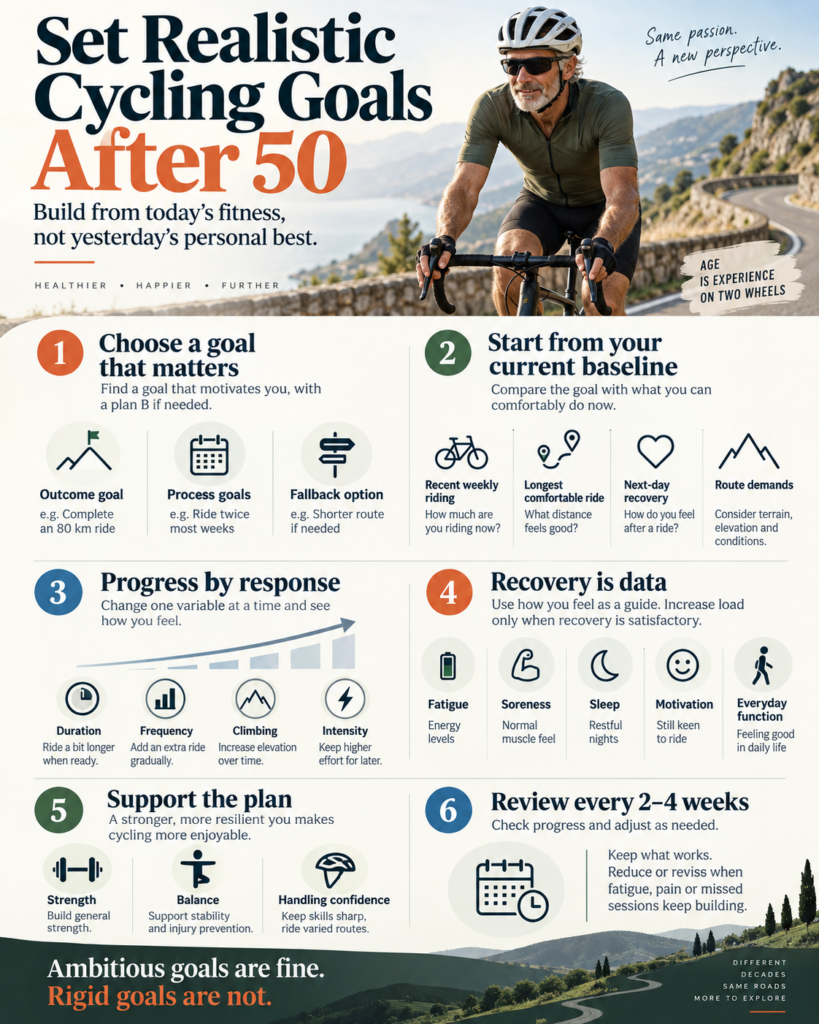
Set the target from a current baseline
Before building toward a long ride, take stock of what you are doing now. Look at your recent weekly riding time, the longest ride that felt comfortable, how hard those rides felt, and how you felt later that day and the following morning. Note recurring symptoms, previous injuries, time available and the conditions you can realistically train in.
This is a snapshot, not a fitness test. If you are returning after illness, injury or a long break, trying to prove your capacity with a maximal ride can give you little useful information and make the return harder. Start with rides that are manageable in your current circumstances. If a health condition or recent medical event affects exercise, seek individualized advice before using training to test your limits.
Compare the planned event with that baseline. A gap between your longest comfortable ride and the event distance does not automatically mean the goal is unrealistic, but it does mean the preparation needs to account for that gap. Consider whether you have enough time to build gradually, whether the event’s hills and surfaces match your experience, and whether your available riding days allow for recovery.
Use time, effort and route demands alongside distance. A ride lasting several hours may be more relevant to a long event than a short ride at a high average speed. Speed, heart rate and power can be useful if you already use them, but none should stand alone: terrain, weather, fatigue, medication and equipment can all affect the number. Perceived effort and how you recover help put the data in context.
Progress by response, not by a fixed percentage
There is no universally validated mileage increase or ten-percent rule that suits every cyclist. A rider’s response depends on their recent training, health, experience, total workload and recovery. Increase training cautiously, and when possible change one major factor at a time: ride duration, frequency, climbing, intensity or technical difficulty. If you increase all of them together and develop persistent fatigue or pain, it is harder to tell what was too much.
For example, if longer rides are the priority, you might first make one ride gradually longer while keeping the rest of the week familiar. Once that feels manageable and recovery is satisfactory, consider another change. If your riding time has been low, adding regular short rides may be a more useful first step than attempting a dramatic weekend distance.
Recovery should be judged by your response, not your birth year. Research on masters athletes is limited and varies by exercise type. It does not support a universal rule that everyone over 50 needs a set number of extra rest days. Some demanding exercise, particularly when it causes substantial muscle damage, can delay recovery; other cycling sessions may not produce the same pattern. Notice whether fatigue, soreness, sleep, motivation and everyday function return before adding more load.
A demanding ride followed by ordinary tiredness is different from a response that persists, worsens or affects normal activities. If the latter happens, reduce or pause training and consider whether the plan needs changing. Do not treat ongoing pain or unusual symptoms as something you simply have to accept because of age.
For disrupted weeks, make three versions of a key session before you need them. The target version is the planned ride; the reduced version might be a shorter or easier route; the recovery option could be rest or gentle mobility rather than trying to cram missed training into the remaining days. A fallback preserves the habit without requiring you to complete a session that no longer fits the circumstances.
Build strength and balance into the wider plan
Cycling develops aerobic fitness, but it does not necessarily provide all the activity recommended for general health. Public-health guidance for adults aged 65 and over commonly includes at least 150 minutes of moderate aerobic activity a week, or 75 minutes of vigorous activity, alongside muscle-strengthening activity on at least two days and balance activity. These are broad health recommendations, not a cycling-event plan or a requirement to reach the target immediately.
The US CDC guidance for older adults and NHS guidance for adults aged 65 and over both encourage activity to be adapted to ability and health. Wording and age categories vary across countries, so check the current advice from your local public-health authority. Riders aged 50 to 64 should not read a 65-and-over category as a training rule for their own age group.
Strength and balance work can support a broader goal, particularly if everyday function, confidence handling the bike or a history of falls matters to you. The appropriate exercises depend on ability and health; cycling alone should not be assumed to replace strengthening or balance activity. If balance has changed or you have had falls or near-falls, address that risk rather than trying to solve it simply by riding more slowly.
A smaller starting volume can still be worthwhile. Evidence on exercise in older adults suggests fitness can improve with training, including in some programmes using lower weekly frequency. That does not predict an individual result or specify how to prepare for an event. It does mean that a modest, sustainable routine can be a reasonable starting point when a larger one is not currently practical.
Two ways to make the framework concrete
Imagine a fit 58-year-old returning after a winter with little riding and aiming for a summer sportive. The previous year’s longest ride may feel like an obvious benchmark, but it does not show what the rider can comfortably manage now. A more useful start is to note current weekly riding, a comfortable ride length and how quickly they recover. The outcome might be completing the sportive; process goals might be regular rides and strength work. The route’s climbing and available training time then help determine whether the event is a suitable target and what needs building first.
Now consider a 67-year-old who rides regularly but manages osteoarthritis and has some balance concerns. A long-distance event may still be appealing, but distance alone is not enough to set the goal. Route surface, climbing, opportunities to stop and confidence in handling the bike matter. The outcome could be completing a supported ride at a sustainable effort, while process goals focus on consistent riding and activity suited to their strength and balance needs. Any pain or health restrictions should guide the plan with appropriate clinical advice; the example is not a prescription.
In both cases, success can include better consistency, confidence or recovery, not only speed. If the original event stops fitting the rider’s health, available time or response to training, changing the goal is a planning decision, not a failure.
Review the goal before it becomes an obligation
Every two to four weeks is a practical point to review a training block, though it is not a scientifically fixed interval. Record what you actually rode, including duration and route demands, alongside effort, sleep, soreness, pain and how you felt the next day. Then ask whether the work is moving you toward the goal and whether you are recovering well enough to continue.
If the plan feels manageable and recovery is good, continue or make one measured change. If you are repeatedly missing sessions, feeling unusually fatigued, or finding that pain is increasing, reduce the load or revise the target. If a symptom is medically concerning, do not try to solve it by changing the goal alone.
Write down one outcome that matters now, two or three actions you can control, and a reduced option for difficult weeks. That gives you a target to pursue and a way to change course when your current capacity or circumstances change.