Starting cycling after 50 does not require a special training formula. It does call for a sensible first step: choose a bike you can control comfortably, practise away from traffic, and begin with rides short enough that you finish feeling capable of riding again. Build duration gradually, according to how you recover, rather than aiming for a particular distance or pace.
That approach works whether you are new to cycling, returning after years away, or already active in another sport. Your current fitness, balance, mobility, health and familiarity with the bike matter more than your age alone. There is no evidence-based starting mileage or weekly increase that suits everyone. Think of the first few weeks as a chance to develop two things at once: a manageable riding habit and the skills to handle your bike calmly. Fitness will build along the way, but there is no need to turn every ride into a test.
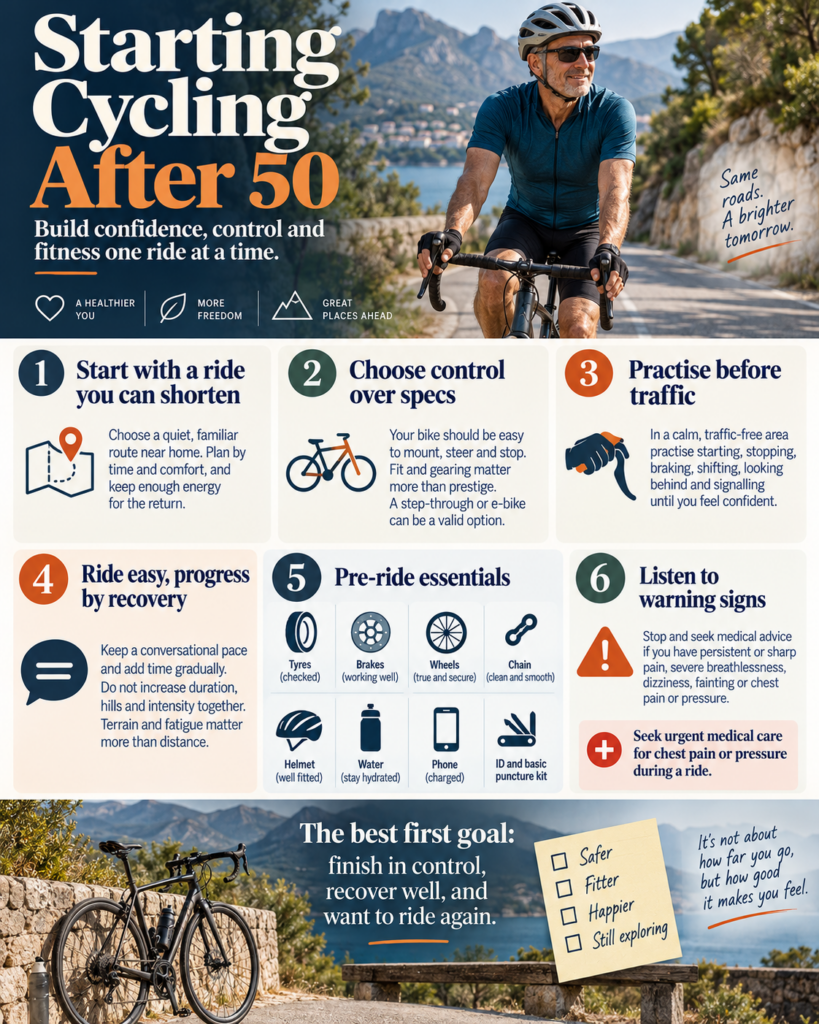
Choose a first ride you can shorten or abandon
Start on a quiet, familiar route with little traffic, a forgiving surface and easy ways to head home. A flat park path, quiet residential loop or short out-and-back may be more useful than a scenic route with steep hills or no convenient exit. Riding in daylight and choosing a time with less traffic can make it easier to concentrate on handling.
Plan by time and comfort, not by distance alone. A short ride of 10 to 15 minutes may be enough for someone who has been inactive or feels uncertain on a bike. Someone who already walks regularly or exercises in another way may be comfortable starting with more. These are options, not age-based rules or a required progression schedule.
One practical example is two short rides during the week and one somewhat longer ride at the weekend, with a rest day or easy activity between them. The rides do not need to be identical. The purpose is to get several relaxed chances to practise without making daily riding a requirement. If you feel unusually tired afterwards or are still recovering when the next ride comes around, make the next outing shorter or take more time between rides.
Before you set off, consider the return as well as the outward leg. Wind, a slight climb or an unfamiliar junction can make the ride home more demanding. Choose a route that leaves you with enough energy to get back comfortably, rather than one that only feels easy at the start.
Make the bike easy to manage, not impressive on paper
The right bicycle is the one that suits your routes and that you can mount, control and stop with confidence. A flat, paved route may call for a different bike from gravel paths or rougher trails. If you have difficulty lifting a leg over a high top tube, a frame with easier step-through access may help. If local rides include hills, look for gearing that makes climbing manageable rather than focusing on how many gears the bike has.
Pay attention to fit and control before accessories or upgrades. You should be able to reach the brake levers comfortably, steer without feeling stretched, and place your feet securely when stopping. The saddle, handlebar position and controls can often be adjusted, but there is no universal saddle-height formula or one ideal position for every body. Flexibility, proportions, previous injuries and bicycle geometry all affect what feels workable.
A bike that feels acceptable during a brief shop visit may become uncomfortable on a longer ride. If discomfort persists, have a bike shop check saddle position, reach, controls, brakes, tyres and gearing. A professional fitting can be particularly useful if you have a previous injury or keep having trouble after basic adjustments, but it is not compulsory for every beginner. Change one adjustment at a time so you can tell whether it helped.
An e-bike is another option if hills, distance or confidence are barriers. Assistance can make it easier to manage effort, but it does not remove the need to practise braking and handling. E-bikes can also be heavier than non-assisted bikes, and battery range depends on factors such as terrain and assistance level. Before buying, consider whether you can lift and manoeuvre the bike, how you will charge it, and whether its classification is permitted on the routes you plan to use. Check local rules and the manufacturer’s instructions.
Practise control before adding traffic
Balancing is only part of riding safely. In a traffic-free area, practise starting, stopping smoothly, braking firmly under control, changing gears, looking behind you and signalling. Also rehearse getting on and off the bike without rushing. These skills are easier to learn when there is no vehicle or group immediately behind you.
When you do move onto roads or shared paths, start with routes that match your current handling and confidence. The rules for road positioning, signalling, riding on sidewalks and using shared paths vary by country and locality, so check the rules where you ride. A route used by cyclists in one place may have different restrictions elsewhere.
Keep your attention on the surroundings, particularly while you are still getting used to the bike. Avoid distractions that make it harder to hear or notice traffic and other path users. If a junction or descent feels too demanding, stop somewhere safe and reconsider the route rather than pressing on because you planned to complete it.
Wear a correctly fitted helmet, and use lights and visibility equipment suited to the light, weather and traffic conditions. Helmet and lighting laws differ across jurisdictions, so check local requirements. A helmet is protective equipment, not a guarantee against injury, and being visible does not replace careful riding.
Keep early effort comfortable and progress by recovery
For initial rides, aim for easy to moderate effort. A useful informal check is whether you can speak in complete sentences while riding. This is a practical guide, not a validated training prescription for every beginner. Hills, heat, medication, health conditions and e-bike assistance can all affect how hard a ride feels.
At first, add riding time only after the current amount feels manageable and you are recovering well. You might extend one ride slightly while keeping the others short, or repeat the same route until it feels familiar. There is no need to increase every ride or follow a fixed weekly percentage. If a longer outing leaves you drained, return to a duration you can handle and give yourself more recovery time.
Distance can be a poor measure of difficulty. A short route with hills, rough ground or complicated traffic may demand more than a longer, flat path. When deciding whether to increase a ride, consider the terrain, how much attention it required, how you felt afterwards and whether normal daily activity feels comfortable the next day.
General activity targets are longer-term goals, not first-week assignments. For adults aged 65 and older, CDC guidance recommends at least 150 minutes of moderate-intensity aerobic activity each week, along with muscle-strengthening activity and balance work. The recommendation concerns overall physical activity, not a required cycling schedule. A new rider can build towards it gradually, and cycling alone may not address strength or balance needs.
Check the bike and carry the basics
A recently bought bike is not automatically ready for every ride, and a bike that has been stored for months may need attention. Before setting off, check that the tyres are in good condition and inflated within the range specified for them, the brakes work, the wheels are secure, the chain is in place, and lights function if you need them. For an e-bike, check the battery charge and follow the manufacturer’s guidance for charging and use.
Carry water, a phone, identification and a way to deal with a common puncture, such as a spare tube or another compatible repair solution, plus the basic tools needed to use it. What you need depends on the bike and route. If you do not yet know how to fix a puncture, learn the process before relying on it far from home, or choose routes where help is easy to reach. Special clothing is not essential for a first ride. Wear comfortable clothes that do not catch in the bike, and choose layers suited to the weather. If saddle or hand discomfort appears, look at ride duration, bike setup and contact points rather than assuming that expensive clothing or a new saddle is the automatic fix.
Separate adjustment discomfort from warning symptoms
Unfamiliar pressure at the saddle or hands can arise when you begin riding, but it should not be ignored if it persists or gets worse. First check whether the ride was longer than you were ready for and whether the bike’s position or contact points need adjustment. Sharp or severe pain, pain that changes how you move, or symptoms that continue despite reducing the workload call for more than simply riding through them.
Seek individualized medical advice before starting or substantially increasing exercise if you have unexplained chest pain, marked breathlessness with mild activity, fainting or near-fainting, serious balance difficulty, new severe joint pain, recent major surgery, a recent cardiac event, or a serious illness that sharply reduced your activity. These are reasons to get advice, not a diagnosis. Chest pain or pressure during a ride warrants urgent medical care; stop riding and seek help.
A health condition, medication or previous injury does not automatically rule out cycling, but it may change what is comfortable or appropriate. If you are uncertain, ask a clinician who knows your circumstances. You may also need to adjust the bike or route, use assistance on hills, or begin with shorter outings.
Make the next ride a small, informed step
After each early ride, use a few practical questions to decide what comes next: Did the route feel manageable? Were you able to control the bike without rushing? Did any discomfort settle, persist or worsen? Were you recovered in time for your usual activities? If the answers are reassuring, repeat the ride or extend it modestly. If not, shorten the route, change one setup detail or allow more recovery before trying again.
The aim is not to prove that you can ride a certain distance. It is to find a bike, route and effort level that make the next ride a sensible choice. Start with a short, low-pressure outing, practise the controls somewhere quiet, and build from what you can comfortably repeat.