If you are looking for the best crank length for older cyclists, age alone does not provide a sound reason to change. The research supplied for this article contained no usable sources to verify an age-specific recommendation or quantify effects on pain, power or performance. A responsible answer is therefore not a particular length, but a way to decide whether a change suits your fit and riding.
Crank length affects the size of the pedal circle and the positions your hip and knee pass through on each revolution. That can matter if you are trying to improve clearance or comfort in a particular riding position, but a new length also changes fit coordinates and how the bike feels. Shorter cranks are not automatically more comfortable, and longer ones do not guarantee more power. Before buying parts, identify the problem you want to solve. If the concern is discomfort, poor cadence or difficulty riding in an aerodynamic position, crank length is one possibility among several. Saddle height, reach, cleat position, gearing, riding load and other aspects of fit may also be involved.
Age alone is not a crank-length fitting method
There is no defensible age-based prescription in the material available for this article. Cyclists of the same age can have different leg and torso proportions, joint mobility, riding positions, training histories and goals. Those individual differences matter more to a crank-length decision than the number of birthdays someone has had.
Mobility, injury history and comfort may be relevant for an individual rider, but they should not be treated as inevitable effects of getting older. A rider who feels crowded at the top of the pedal stroke may have a different reason to test shorter cranks than someone who feels comfortable on their current setup and wants to preserve it for long rides or racing.
Height-based charts and crank-length formulas can offer a starting point, not a verdict. They cannot account for every rider’s proportions, bike position, preferred cadence or component constraints. Nor does a chart establish that changing length will relieve pain or improve performance.
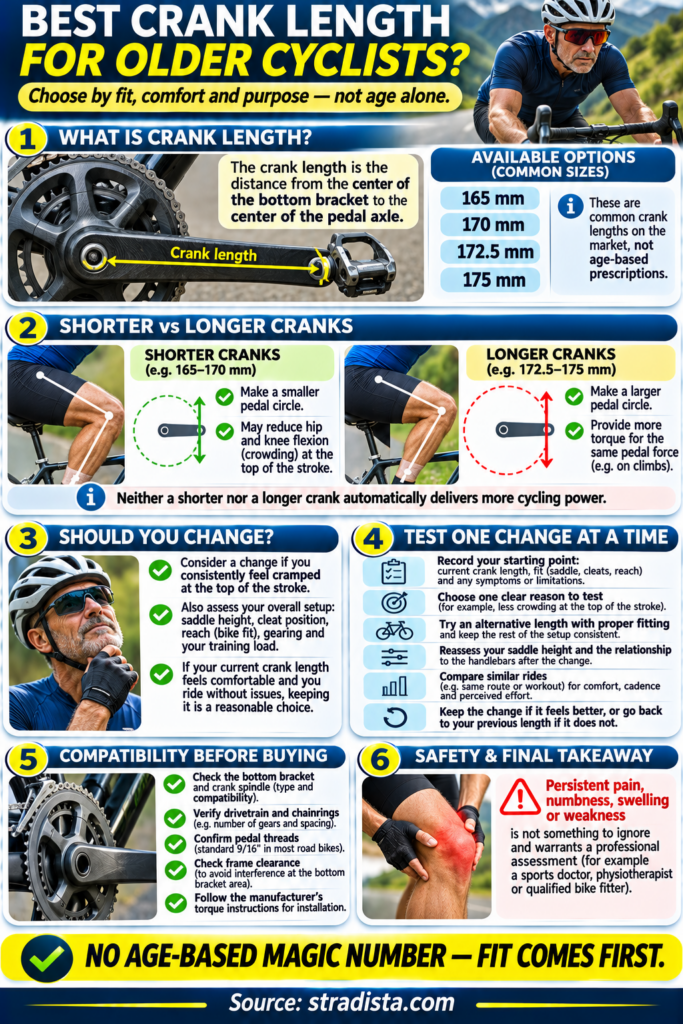
Crank length changes the pedal circle and your fit
Crank length is the distance from the centre of the bottom bracket to the pedal axle. A longer crank moves the pedal through a larger circle; a shorter one moves it through a smaller circle. As a result, the knee and hip travel through a different range of positions during each revolution.
A shorter crank places the pedal lower at the top of the stroke and higher at the bottom, compared with a longer crank. That may create more room at the top of the pedal stroke for some riders, particularly in a position where the hip is already flexed. But whether that improves comfort depends on the rider and the rest of the fit. It is not a treatment for hip or knee pain.
Crank length also changes leverage. With the same force applied to the pedal, a longer crank produces more torque at the bottom bracket. That does not mean it necessarily produces more power: pedalling involves force, cadence and movement through the stroke, and the available research package does not establish a universal performance advantage for either length. A change may feel different without improving a rider’s actual output.
Crank length is not gearing. Gearing determines how far the bike travels for a given wheel rotation and gear selection; crank length changes the lever and the pedal circle. If a climb feels too hard, a lower gear may address the problem more directly than changing crank length. A crank swap should not be treated as a substitute for suitable gearing.
Fit coordinates change as well. If you install shorter cranks and leave the saddle untouched, the pedal at the bottom of the stroke sits higher relative to it, increasing the distance between saddle and pedal at that point. Adjusting the saddle may restore a comfortable leg position, but that adjustment also changes the saddle’s relationship to the bars. The new setup needs to be assessed as a whole, not by crank length in isolation.
Start with the riding problem, not a number on a chart
Before considering a replacement, note when the issue occurs and what it feels like. Does discomfort appear only on long rides, only in a low riding position, or mainly when climbing? Is the concern that your hip feels crowded at the top of the stroke, that you cannot find a comfortable cadence, or that a joint hurts? These observations do not diagnose the cause, but they make it easier to decide what to investigate.
Consider the rest of the setup and the demands of your riding. Saddle height and fore-aft position, reach, cleat placement, riding posture, cadence, terrain and recent changes in training load can all affect how pedalling feels. A new pain after a sharp increase in riding may call for reviewing workload as well as fit. Changing several things at once makes it harder to tell what helped.
Your goal matters, too. A rider who wants a more comfortable position for steady recreational rides may judge a change differently from someone focused on a particular performance demand. There is no universal “best” crank length that optimizes comfort, cadence, climbing and power for every rider.
If your current setup is comfortable and works for the way you ride, keeping it is a reasonable choice. A change involves cost, compatibility checks and a period of reassessing fit. It is more compelling when you have a specific, repeatable problem that a different pedal circle might address, rather than a general belief that shorter cranks are better after a certain age.
Test a different length as a controlled fit change
A careful test is more useful than choosing a new length because it appears on a chart. If possible, work with a qualified bike fitter who can assess your position and help isolate whether crank length is a plausible factor. This is particularly useful if discomfort has persisted despite reasonable setup changes or if you are unsure how to adjust saddle position after the swap.
- Record your baseline. Note your current crank length, saddle position, riding posture, usual cadence and the rides or situations in which the problem appears. Describe symptoms specifically, including when they begin and whether they continue after riding.
- Choose one reason to test. For example, you might be investigating a feeling of crowding at the top of the pedal stroke. Avoid changing the cranks, cleats, saddle and training load all at once, or the result will be difficult to interpret.
- Plan the fit adjustments. A different length changes the pedal’s position at both ends of the stroke. Reassess saddle height and the resulting relationship to the bars rather than assuming the old measurements still suit you.
- Compare similar rides. Use familiar routes and riding conditions where practical. Pay attention to comfort, cadence and control as well as effort. One ride may not tell you enough to distinguish a lasting improvement from a new sensation or a change in conditions.
- Keep or reverse the change based on the result. If the original problem remains, worsens or is replaced by another fit issue, the crank change has not solved the problem. Reassess the rest of the setup instead of persisting simply because the component has already been bought.
This process can help you judge whether a different length suits your riding, but it cannot establish a medical cause for pain or guarantee a performance gain. If you are comparing lengths for a specific performance goal, consider how the whole position and your gearing affect that goal, rather than judging only by how the cranks feel during a short trial.
Check compatibility before buying replacement cranks
Crank arms are not interchangeable solely because they have the desired length. Confirm compatibility with the bike’s bottom bracket and frame, as well as the drivetrain and chainrings. Check pedal-thread compatibility, crank-arm clearance and, where relevant, interaction with the front derailleur or electronic shifting. The exact requirements depend on the parts fitted to your bike.
Before ordering, verify the specifications for your particular components with the relevant manufacturer or a competent mechanic. Do not assume that a crankset that physically fits the bottom bracket will work correctly with the chainrings, drivetrain or frame. A mechanic can also check whether the intended length is available in a compatible crankset.
Crank installation must follow the crank and bottom-bracket manufacturers’ instructions, including the specified torque and assembly procedure. Those details vary by system, so a generic torque value or a method meant for a different crank is not a safe substitute. If you are not confident identifying the system or following its instructions, have the parts installed by a qualified mechanic.
Know when crank length is not the right first step
Persistent or worsening pain should not be managed solely by swapping components. A bike fitter can help assess position and equipment, while a healthcare professional can evaluate symptoms that may have a cause beyond bike fit. Seek appropriate assessment if pain is severe or unusual, continues outside cycling, or comes with swelling, marked weakness, numbness or loss of coordination. Acute pain that prevents normal walking or daily activity also needs more than a crank-length experiment.
Do not assume that shorter cranks will prevent or cure knee, hip or back pain. The available research for this article cannot support that claim, and discomfort may have several possible contributors. If symptoms remain after reasonable fit adjustments and reducing or modifying riding load, get professional advice rather than continuing to make isolated equipment changes.
Make the decision on fit and purpose, not age
There is no evidence-based reason in the available material to prescribe shorter cranks to every cyclist over 50. If your current length is comfortable and compatible with your riding goals, there is no need to change it simply because of age. If you have a specific fit or comfort concern, treat another length as a controlled test, adjust the fit around it and check that the parts are compatible.
The most useful next step is to describe the problem precisely and review your current setup before buying anything. If the cause is unclear, a bike-fit assessment can help determine whether crank length is worth testing or whether another part of the fit is the more practical place to start.