A road bike can be too long even when its frame size looks right on a chart. The practical test is whether you can reach the hoods and brake levers in a relaxed, controlled position, not whether one geometry number or visual alignment rule says you should fit.
If you repeatedly lock your elbows, reach your shoulders toward the bars, slide forward on the saddle or put excessive weight through your hands, excessive reach is one possibility. But those signs do not prove the frame is too large. Saddle position, handlebar shape, hood placement and bar height can all affect how far away the controls feel. Before replacing a bike, check the whole position and make small, reversible adjustments one at a time. A frame change makes more sense when a comfortable, controlled position cannot be achieved without compromising the saddle position, cockpit setup or handling.
Frame reach is not the same as reach to the controls
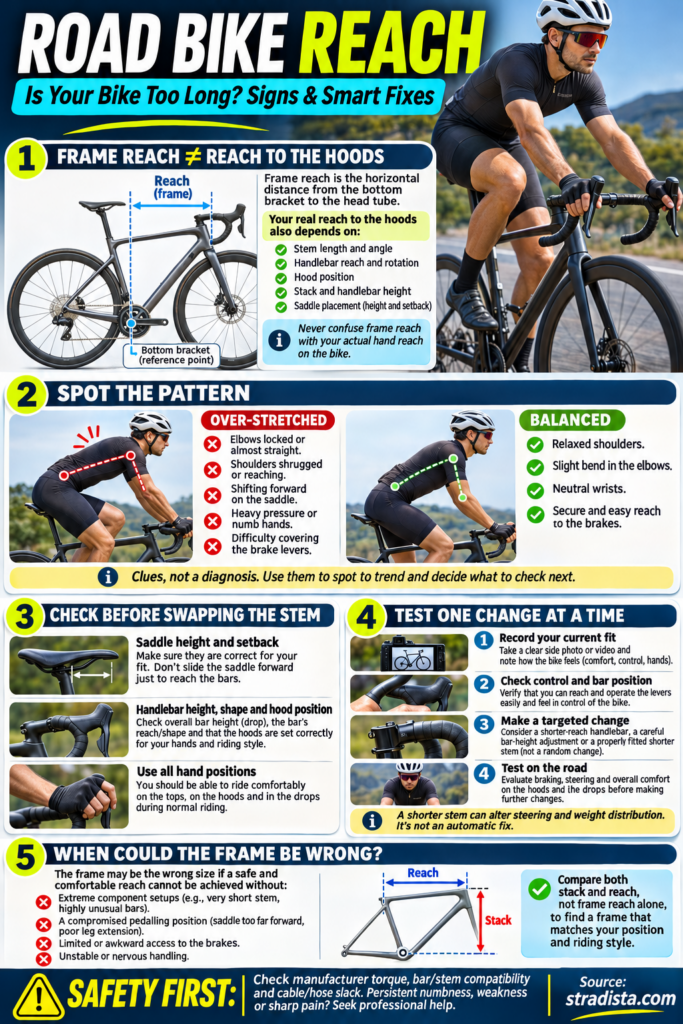
Frame reach is a geometry measurement: it describes the horizontal distance between reference points on the frame, commonly the bottom bracket and head tube. It helps compare frames, but it does not tell you exactly how far your hands will be from the saddle or how you will feel riding the bike.
Your practical reach to the controls also depends on the frame’s stack (its vertical geometry), stem length and angle, handlebar reach and rotation, hood position, and saddle height and setback. Your proportions, mobility, riding position and experience with that position matter too. Two bikes with the same published reach can therefore feel different, and geometry figures are most useful when comparing frames measured using the same convention.
The relevant question is whether you can use the positions you need, especially the hoods and drops, without straining or losing control. A position may feel fine while sitting on the tops but become uncomfortable when you reach forward to brake from the hoods. It may also feel acceptable for a short spin and become tiring on a longer ride.
Look for a pattern, not one telltale sign
A cockpit that is too long may leave you feeling stretched toward the hoods, with elbows locked or nearly locked and shoulders held forward or shrugged. You may find yourself sliding toward the front of the saddle to reach, supporting a lot of weight through your hands, or struggling to cover the brake levers comfortably. Neck, shoulder or back tension can also be clues.
These are prompts to investigate, not a diagnostic checklist. No single elbow angle, front-wheel alignment or other visual rule can establish that your reach is correct. Riders differ, and the same complaint can have several explanations. For example, hand numbness can relate to pressure distribution, wrist position, gloves, bar tape or other fit and health factors, not just cockpit length.
Consider when the problem appears. Does it happen only on the hoods, or also on the tops and in the drops? Does it start after a certain amount of time, worsen as you tire, or occur mainly when braking or descending? A difficulty reaching the levers is a control concern even if you are otherwise comfortable. Persistent or worsening symptoms, or symptoms that continue after you get off the bike, need more than a reach adjustment.
Check the whole position before changing the stem
Start with the bike as it is now. Note the saddle height and setback, the approximate difference in height between saddle and bars, stem length, handlebar shape and rotation, hood position, and which hand positions you use most. A side photograph or video on a stationary trainer can help you observe your posture, but it is not a pass-or-fail fit test. Look for whether you can keep your shoulders relaxed, wrists reasonably neutral and elbows comfortably soft while reaching the controls.
Check the saddle before shortening the cockpit. If it is too far back, the bars may feel farther away than they otherwise would. If the saddle is too high, you may have difficulty staying settled on it. However, do not move the saddle forward simply to bring the bars closer if that puts your pedalling position in a poor place. Saddle position should work for pedalling as well as for reach.
Then inspect the bar and controls. A handlebar with relatively long reach, or bars and hoods rotated too far forward, can put the controls farther away. Bar drop can matter too: if the bars are much lower than you can comfortably use, you may strain or shift position to reach them. Cleat position, crank length, flexibility and fatigue can also affect how a setup feels, so avoid treating every symptom as a cockpit problem.
After checking the stationary position, assess the bike in the hand positions and situations that matter to you: climbing, braking from the hoods, riding in the drops and descending. A short static check cannot show whether you can maintain the position comfortably as you tire. If the bike causes sharp pain, weakness, persistent numbness or loss of control, do not extend the ride just to test the setup.
Make the smallest useful cockpit change
When the saddle position is appropriate and the frame otherwise suits you, small cockpit changes may be enough. If the controls are extended by the way the bars or hoods are set, adjusting their position may help. A handlebar with shorter reach can bring the controls closer without changing the stem. Raising the bars may help when excessive drop is part of the problem, though it can reduce how low you can ride and may require more cable or hose length.
A shorter stem is another option, but it is not an automatic fix. It can change steering feel and weight distribution, and a very short stem may be a sign that the frame and the rider’s proportions do not work well together. The right choice depends on the bike, the amount of correction needed and how the bike feels afterward.
Change one thing at a time and record what you changed. That makes it easier to tell whether the adjustment helped or created another problem. After each change, check your access to the brake levers and reassess the hoods, tops and drops, as well as your confidence while steering and braking. A setup that brings the hoods closer but makes the bike feel awkward or leaves you unable to reach the drops comfortably may not be a good overall solution.
Before changing a stem or handlebar, check the manufacturer’s instructions and compatibility limits for the steerer, stem, handlebar and controls. Follow the specified clamping and torque requirements, and confirm that cables or hydraulic hoses have enough slack for the new position and for steering. If you are unsure how to assess these details, have a qualified mechanic do the work rather than guessing.
When the frame itself may be the wrong size
A frame becomes a more likely concern when you cannot achieve a relaxed, controlled position without extreme cockpit changes or compromises elsewhere. Warning signs include needing a stem or spacer arrangement outside the manufacturer’s approved limits, having to move the saddle to an unsuitable position just to reach the bars, or finding that brake access and handling suffer after attempts to shorten the cockpit.
That does not mean every short stem or high handlebar proves the frame is wrong. Riders and bikes differ, and the right setup depends on the frame’s geometry and the components fitted. The concern is whether the whole arrangement works safely and coherently, not whether one part looks unusual in isolation.
If you are comparing a different frame, consider stack and reach together rather than choosing by frame reach alone. Also account for the stem, bars, hood position and saddle location you are likely to use. If possible, get help comparing the complete riding position, because a nominally smaller frame does not automatically put the controls in a better place for every rider.
Know when a fit or medical assessment is the better next step
An experienced bike fitter can be useful when the source of the problem is unclear, several adjustments have not helped, or changing one part seems to disturb another. This is particularly helpful if you have a history of neck, shoulder, back or hand problems, or if mobility affects the positions you can sustain. Age alone does not determine the right reach, but previous injuries and individual mobility can affect how comfortable a stretched position is.
Seek medical assessment rather than assuming the bike is responsible if you have persistent numbness, weakness, grip difficulty, radiating neck or arm pain, sharp pain, or symptoms that recur away from the bike. These signs are not a diagnosis, but they should not be dismissed as ordinary adaptation or treated only by moving the bars.
If you can reach the controls with relaxed shoulders, soft elbows and reliable brake access, and the position remains comfortable across the hand positions you use, the frame may not be too long. If you cannot get that control without compromising the rest of the bike, pause component swapping and have the complete fit assessed before deciding whether the frame needs to change.